
Why Are Pokémon Cards So Expensive? The Real Reasons Behind Pokémon Card Prices
Why are Pokémon cards so expensive? It's a question being asked increasingly often as rare Pokémon cards sell for hundreds, thousands and, in exceptional cases, millions.
The traditional explanation for expensive Pokémon cards is simple: rarity, condition, nostalgia and demand. All four remain extremely important. But in 2026, there is another side to the story.
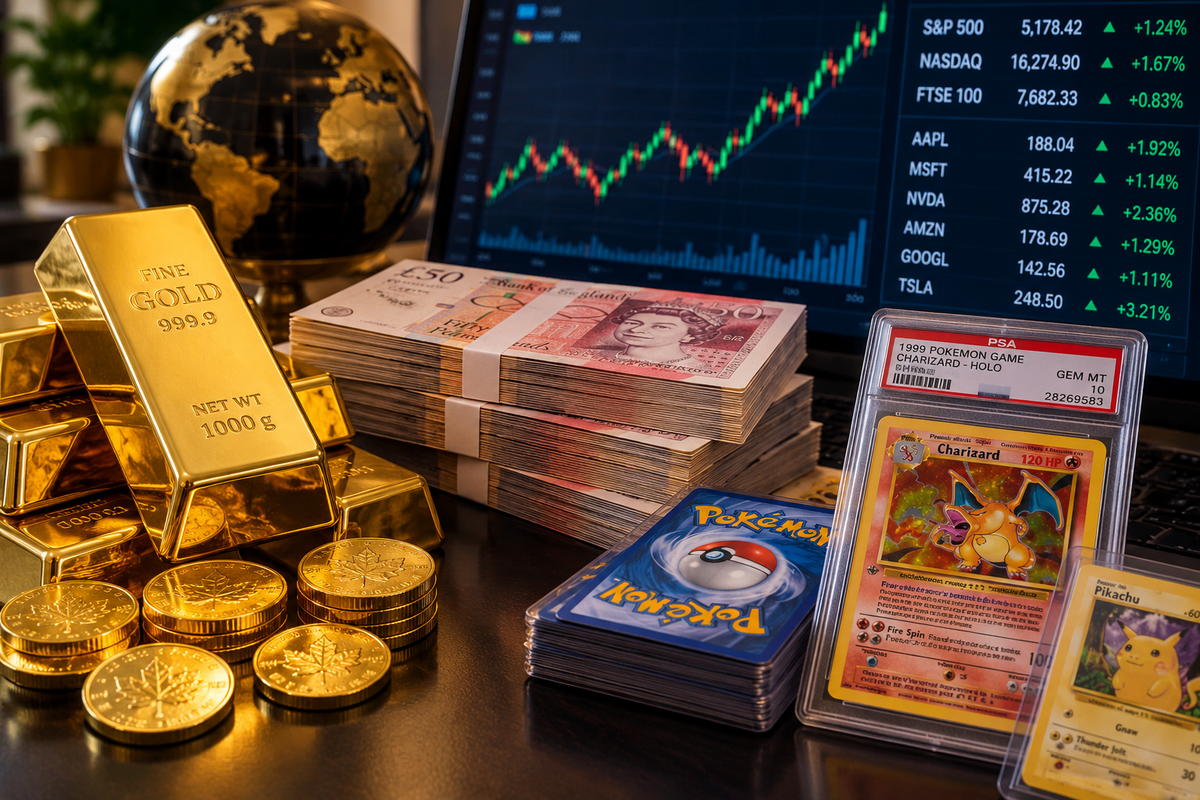
Pokémon cards now sit at the intersection of collecting, investing and speculation.
At one end of the market, working- and middle-class collectors facing increased living costs are exploring side hustles, reselling and alternative ways of making money. At the other end, the high-value collectibles market can attract people with enormous amounts of disposable capital, including bankers, hedge-fund and finance professionals, venture capitalists, entrepreneurs, multimillionaires, billionaires and celebrities.
When buyers with completely different levels of wealth compete for a limited number of desirable cards, the result can be significant price movements.
Add professional grading, social media, global online marketplaces, investment speculation and a generation of adults with money to spend on something they loved as children, and it becomes easier to understand why Pokémon cards are so expensive today.
Why Are Pokémon Cards So Expensive Right Now?
There isn't one reason why Pokémon cards are expensive.
Instead, several factors are happening simultaneously: increased collector demand, limited supply, professional grading, nostalgia, social-media exposure, speculation and growing interest in collectibles as alternative assets.
Pokémon cards were traditionally bought primarily to play with or collect. Today, some buyers have a third motivation: making money.
Collectors now track Pokémon card prices, PSA populations, previous sales, auction results and sealed-product values. Some buyers analyse cards in ways that wouldn't look completely out of place when researching conventional investments.
That doesn't mean every collector is an investor. Millions of people simply enjoy collecting Pokémon cards.
But money has undeniably become a bigger part of the hobby.
What Makes Pokémon Cards Valuable?
To understand why some Pokémon cards are worth so much, you first need to understand what makes a Pokémon card valuable.
The biggest factors are rarity, condition, demand, popularity, artwork, age and grading.
A rare card isn't automatically valuable. There also needs to be sufficient demand for it.
Likewise, an old Pokémon card isn't automatically expensive simply because it's old.
The cards that command the highest prices usually combine several desirable characteristics at once.
A rare card featuring an extremely popular Pokémon, in exceptional condition, with desirable artwork and very few comparable copies available can create exactly the conditions required for a high price.
Ultimately, Pokémon card prices are still driven by one of the oldest economic principles:
supply and demand.
Why Are Rare Pokémon Cards So Expensive?
Some Pokémon cards are genuinely difficult to obtain.
Certain cards were originally produced in tiny numbers. Others were widely distributed, but relatively few copies survived in excellent condition.
Vintage Pokémon cards have another important characteristic: their original supply is fixed.
Nobody can go back to 1999 and print more original 1999 Pokémon cards.
Some of those cards have been lost, damaged or placed into permanent collections over the last quarter of a century.
The number of desirable examples actually available for sale can therefore be much smaller than the number originally printed.
If thousands of collectors want a card but relatively few owners are willing to sell, the price can rise substantially.
Why Are PSA 10 Pokémon Cards So Expensive?
Professional grading has created another form of scarcity: condition rarity.
There might be thousands of copies of a particular Pokémon card in existence, but how many have excellent corners, virtually no whitening, a clean surface, strong centring and no significant scratches or defects?
Suddenly the number becomes much smaller.
Grading companies such as PSA assess cards and assign condition grades. Collectors can also use population reports to see how many examples have achieved particular grades.
This helps explain why a PSA 10 Pokémon card can sometimes cost considerably more than the same card in PSA 9.
The buyer isn't simply buying a particular Pokémon card.
They're potentially buying one of the best surviving examples of that card.
Why Are Charizard and Other Popular Pokémon Cards So Expensive?
Rarity isn't enough on its own.
People have to actually want the card.
Certain Pokémon have enormous collector followings. Charizard and Pikachu are obvious examples, while Pokémon such as Umbreon, Eevee, Gengar and Mew can also attract substantial demand.
Imagine two cards with exactly the same rarity.
One features a relatively unpopular Pokémon.
The other features Charizard.
If considerably more collectors want the Charizard, its price can be much higher despite the cards having similar rarity.
This is why Pokémon card value depends on both scarcity and demand.
Scarcity without demand doesn't necessarily create a high price.
Scarcity combined with enormous demand can.
The Cost of Living and the Search for Alternative Income
There is also a wider economic story behind modern Pokémon card prices.
For many working- and middle-class households, recent years have brought significant financial pressures. At the same time, social media has helped popularise side hustles, reselling, investing and alternative ways of generating income.
Pokémon cards fit surprisingly well into this environment.
Someone doesn't necessarily need tens of thousands of pounds to participate. They might begin with a £50 graded card, sell cards from an old childhood collection, submit cards for grading or try to identify undervalued cards for resale.
This means someone buying a Charizard today might be a lifelong collector.
They might also believe the card will increase in value.
And increasingly, they can be both.
Why Wealthy Investors Are Interested in Collectibles
At the opposite end of the Pokémon card market is serious wealth.
High-end collectibles have long attracted wealthy individuals.
Fine art, watches, classic cars, wine, jewellery and rare coins are established examples.
Trading cards are increasingly appearing within the same broader conversation around collectibles and alternative assets.
At the top end, potential buyers can include bankers, hedge-fund and investment professionals, venture capitalists, technology entrepreneurs, multimillionaires, billionaires and celebrities.
This matters because their purchasing power can be completely different from that of an ordinary collector.
For somebody earning an average salary, spending £20,000 on a Pokémon card could be unimaginable.
For somebody worth £200 million, the same purchase represents a tiny proportion of their wealth.
That difference becomes particularly important when extremely wealthy buyers compete for Pokémon cards with genuinely tiny populations.
Why Wealthy Buyers Can Affect Pokémon Card Prices
The global stock market contains enormous liquidity.
The market for one particular rare Pokémon card can be incredibly small.
Imagine there are only ten desirable PSA 10 examples of a particular card currently available.
Then imagine several traditional collectors want one.
A dealer wants one.
A banker wants one.
A technology entrepreneur wants one.
And a multimillionaire or celebrity wants one.
They're all competing for the same ten cards.
One sells for £10,000. Another sells for £12,000. The next owner decides they won't sell below £15,000.
Suddenly the market price has moved substantially.
This doesn't necessarily require millions of new Pokémon collectors.
In a relatively thin market, sometimes it only requires a small number of determined buyers with substantial amounts of money.
The opposite is also possible. If speculators begin selling and there aren't enough genuine collectors willing to buy at existing prices, Pokémon card prices can fall quickly.
This is one reason the market can experience significant price turbulence.
The US Stock Market, AI Boom and Alternative Assets
Another interesting part of the picture is the enormous wealth generated by the US technology sector and AI boom.
Founders, employees, investors and shareholders of successful technology companies can accumulate substantial wealth through rising company valuations and share prices.
When someone's wealth becomes heavily concentrated in equities or one particular industry, diversification may become more important to them.
That doesn't mean wealthy technology investors are all buying Pokémon cards.
But it does help explain broader interest in assets outside traditional stock and bond markets.
That can include property, gold, fine art, watches, classic cars, wine and collectibles.
Pokémon cards now sit, albeit at the unconventional end, within this much wider alternative-assets landscape.
Celebrities Have Helped Make Expensive Pokémon Cards Mainstream
Celebrity involvement has also changed how people perceive Pokémon cards.
High-profile collectors and personalities have brought enormous attention to rare trading cards.
Logan Paul's involvement with the PSA 10 Pikachu Illustrator is perhaps the best-known example. Other celebrities and entrepreneurs, including Steve Aoki, have also been publicly associated with trading-card collecting.
When internationally recognised celebrities publicly buy and display expensive Pokémon cards, millions of people see them.
A Pokémon card can suddenly be perceived less like something from a childhood binder and more like a luxury collectible alongside watches, artwork and classic cars.
That increased visibility can create additional demand.
Social Media Has Changed Pokémon Card Prices
Social media has dramatically increased the speed at which information and excitement move through the Pokémon card market.
YouTube pack openings, TikTok videos, Instagram collections, livestreams and high-profile auctions can expose individual cards to millions of people.
This can create a feedback loop.
A Pokémon card increases in price. People start talking about it. More collectors discover it. Speculators notice the price movement. Demand increases. The card rises again. That attracts even more attention.
Then a celebrity or influencer buys one and the attention increases further.
In financial markets, similar behaviour can be described as momentum.
In collectibles, we might simply call it hype.
FOMO Can Make Pokémon Cards More Expensive
Fear of missing out – or FOMO – can accelerate price movements further.
Imagine a card increases from £200 to £400.
Some buyers don't think, "Is this card worth £400?"
Instead they think, "I'd better buy it now before it's £800."
If enough people behave that way, their buying can itself push the price higher.
But eventually somebody needs to be willing to pay the next price.
If buyers disappear, prices can stagnate. If owners start selling simultaneously, prices can fall.
That's why a rapidly increasing Pokémon card price doesn't necessarily mean the card has permanently become more valuable.
Price and value aren't always the same thing.
Why Are Old Pokémon Cards So Expensive?
Some old Pokémon cards are expensive because they combine nostalgia with increasingly limited supply.
But an important misconception needs addressing:
not every old Pokémon card is valuable.
Age alone doesn't create value.
An old common card with enormous surviving supply and limited collector demand might still be worth very little.
The expensive vintage Pokémon cards tend to combine age with rarity, popularity, condition and demand.
There's also a powerful emotional component.
The children who collected Pokémon during the late 1990s and early 2000s are now adults.
Someone who was eight years old in 1999 is now in their mid-thirties.
The child who desperately wanted a Charizard but couldn't afford one may now have a career and disposable income.
In some exceptional cases, that child grew up to become a banker, fund manager, technology entrepreneur, professional athlete, celebrity or billionaire.
And they can still want a Charizard.
Why Are Modern Pokémon Cards So Expensive?
Age isn't essential either.
Some modern Pokémon cards can become extremely expensive shortly after release.
Modern card values can be influenced by pull rates, artwork, character popularity, set popularity and collector demand.
Special illustration rares and alternative artwork cards have also turned Pokémon cards into miniature pieces of collectible artwork.
Some collectors focus on individual artists. Others collect every card featuring one Pokémon. Some build complete sets, while others exclusively collect professionally graded cards.
That creates multiple overlapping markets.
The person buying a card because they love the artwork can be competing against somebody buying exactly the same card because they believe its price will increase.
Different motivations.
Same limited supply.
Why Are Sealed Pokémon Cards and Booster Boxes So Expensive?
Individual cards aren't the only Pokémon products that can become expensive.
Sealed booster packs, booster boxes and other unopened Pokémon products are also collected.
Vintage sealed products have an interesting characteristic.
Every time somebody opens an old booster pack, there is one fewer sealed example remaining.
Over long periods, the available supply can therefore decline.
Modern sealed products are more complicated because additional supply or reprints can sometimes enter the market. Nevertheless, some collectors deliberately buy sealed Pokémon products with the intention of keeping them unopened for years.
Twenty years ago, the idea of buying Pokémon cards specifically not to open them might have sounded strange.
Today it's an established part of the hobby.
Are Pokémon Cards a Good Investment?
This is a different question from asking why Pokémon cards are expensive.
Pokémon cards can certainly be treated as investments, but that doesn't make them predictable or low-risk investments.
Unlike shares in a profitable company, Pokémon cards don't generate corporate earnings or dividends. Unlike a savings account or certain bonds, they don't pay interest. Unlike a rented property, they don't generate rental income.
Their resale value ultimately depends on another buyer being willing to purchase them.
Pokémon cards can also be illiquid.
Selling a £100 card might be relatively straightforward.
Finding somebody willing to pay £100,000 for a particular card at the exact moment you want to sell it is completely different.
There are also grading fees, auction commissions, marketplace fees, insurance and storage costs, authenticity concerns and sometimes enormous differences between sellers' asking prices and actual completed sales.
Anyone entering the hobby purely because they believe Pokémon cards are an easy way to make money should therefore be extremely careful.
So, Why Are Pokémon Cards So Expensive?
Ultimately, why are Pokémon cards so expensive?
Because several powerful forces have collided.
Pokémon has genuine scarcity, enormous global recognition, professional grading, nostalgia, desirable artwork and millions of collectors.
But today's Pokémon card market also includes dealers, investors and speculators. At the very top end it can attract bankers, hedge-fund and finance professionals, venture capitalists, entrepreneurs, multimillionaires, billionaires and celebrities with extraordinary purchasing power.
At the other end are ordinary collectors, including people looking at cards as a potential side hustle or alternative way of generating income.
Then add social media, FOMO, global marketplaces and the fact that the original generation of Pokémon collectors now has adult disposable income.
The result is an unusual marketplace where a £50 collector and a multimillionaire can theoretically be chasing cards from exactly the same hobby.
That's one of the biggest reasons Pokémon cards can be so expensive.
Our View at benscards
At benscards, we're collectors first.
The financial side of Pokémon is fascinating, and it's impossible to ignore how much the market has changed. But we also think something gets lost when every Pokémon card is viewed purely as an investment.
Markets rise. Markets fall. Today's hottest card might not be tomorrow's. Nobody can guarantee what a particular Pokémon card will be worth in five, ten or twenty years.
Our philosophy is straightforward:
buy Pokémon cards you genuinely want to own.
Learn about rarity. Understand grading. Look at actual sold prices rather than ambitious asking prices. Don't spend money you can't afford to lose, and don't assume that because a Pokémon card has increased dramatically in the past it must continue doing so.
If your collection increases in value, fantastic.
But if Pokémon card prices fell tomorrow, you should still be able to look at your favourite card and be pleased that you own it.
Because Pokémon may now be a serious global collectibles market, but underneath the money, grading, investing and speculation, there's still a hobby.
And that's probably the most valuable part of it.
Important Disclaimer
The information in this article is provided for general information and entertainment purposes only. It does not constitute financial, investment, tax or legal advice, and nothing in this article should be regarded as a recommendation or invitation to buy, sell or hold Pokémon cards, collectibles or any other asset.
The value of collectibles can rise as well as fall, and past price movements are not a reliable indication of future performance. Pokémon cards can be difficult to value and may not always be easy to sell. You could receive back substantially less than you paid for a card.
Any examples of prices, market trends or investment behaviour discussed in this article are illustrative only. You should carry out your own research and consider your individual financial circumstances before spending money on collectibles. Where appropriate, seek advice from a suitably qualified and authorised financial adviser.
benscards is a trading-card retailer and collector and does not provide regulated financial or investment advice.